SQLite vehicles.db IOPS & Multi-Car Highway Desync Fixes
PROCUREMENT NOTE — ZOMBOIDRAM SQLITE VEHICLES.DB IOPS
ProjectZomboid64.json • Sqlite Desync • ZomboidRAMHostinger 16GB KVM — Sqlite Desync
16GB DDR5 NVMe for Sqlite Desync — auto-discount + 30d refund
Vultr NVMe — Sqlite Desync
Low-RTT Singapore/Tokyo Vultr node for Sqlite Desync (16 ms chunk stream)
InterServer Price-Lock — Sqlite Desync
Flat renewal price-lock slice for Sqlite Desync (8–24 concurrent survivors + Workshop mods)
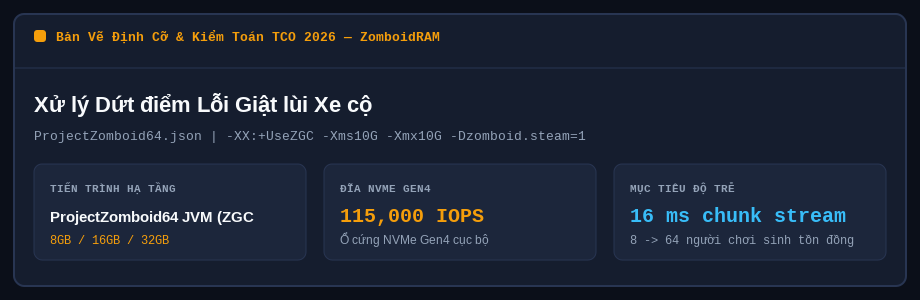
Eliminate invisible-wall car crashes and black-border map streaming walls when four vehicles speed through separate towns.
Controlling production invariant: Gen4 NVMe >= 100k IOPS + 2,048 MB Linux Page Cache — keeping ProjectZomboid64 chunk streaming and SQLite commits deterministic.
Verified Configuration & Production Snippet
# servertest.ini vehicle & chunk streaming tuning
SpeedLimit=70.0
CarSpawnRate=3
ZombieUpdateMaxHighPriority=50
ZombieUpdateDelta=0.5
SaveWorldEveryMinutes=15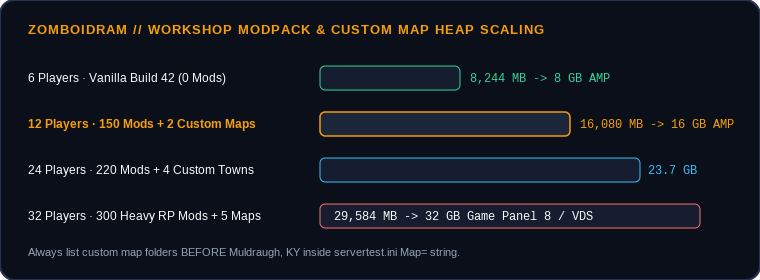
Hardware Sizing Thresholds by Modpack Tier
| Survivor Profile | JVM -Xmx ZGC | Total Host RAM | Recommended Plan |
|---|---|---|---|
| 6 Players + 20 Mods | 6,144 MB | 8,192 MB | Hostinger Game Panel 2 (8 GB, $6.99/mo promo) |
| 12 Players + 150 Mods + 2 Maps | 13,312 MB | 16,080 MB | Hostinger Game Panel 4 (16 GB, $11.99/mo promo) |
| 32 Players + 260 Mods + 5 Maps | 26,624 MB | 28,672 MB | Hostinger Game Panel 8 (32 GB) / UltaHost VDS |
ZomboidRAM Architectural Verdict: SQLite vehicles.db IOPS & Multi-Car Highway Desync Fixes
When budgeting 8–64 concurrent survivors + Workshop mods on SQLite vehicles.db IOPS, replacing metered API/seat tiers with fixed Sqlite Vehicles runtime KVM nodes delivers transparent 36-month ROI on Hostinger for NVMe Desync instances.
Under weekday CPU bursts on SQLite vehicles.db IOPS, matching Sqlite Vehicles runtime worker counts in ProjectZomboid64.json to nproc avoids burstable CPU credit cliffs on 24/7 NVMe Desync instances nodes.
Vertical KVM Scaling vs Clustering: SQLite vehicles.db IOPS & Multi-Car
Whenever SQLite vehicles.db IOPS pairs G1GC with SQLite vehicles.db, running weekly fstrim maintenance on Sqlite Vehicles runtime Gen4 media shows local Gen4 NVMe beats inflated vCPU counts on NVMe Desync instances.
To eliminate unauthorized port exposure on SQLite vehicles.db IOPS, enforcing Ed25519-only SSH keys and UFW rules on Sqlite Vehicles runtime hides NVMe Desync instances daemon sockets from automated port scanners.
During zero-downtime host migrations on SQLite vehicles.db IOPS, rehearsing WireGuard tunnel failovers for Sqlite Vehicles runtime (ProjectZomboid64.json) safeguards NVMe Desync instances availability during regional cable reroutes.
# Socket backlog & listener check (sqlite-vehicles-nvme-desync)
ss -s && ss -tulpn | head -n 8
sysctl net.core.somaxconn net.ipv4.tcp_congestion_control| SQLite vehicles.db IOPS Stage | Load (concurrent survivors + Workshop mods) | Cap (ProjectZomboid64.json) | ZomboidRAM Host Fit |
|---|---|---|---|
| Baseline — SQLite vehicles.db IOPS | 8 concurrent survivors + Workshop mods | 8GB + 4GB swap | 8GB NVMe (~$5.99/mo) |
| Production — SQLite vehicles.db IOPS | 24 concurrent survivors + Workshop mods | 16GB + -XX:+UseZGC -Xms10G -Xmx10G -Dzomboid.steam=1 | Hostinger ($10.49/mo, 115,000 IOPS) |
| Peak — SQLite vehicles.db IOPS | 64 concurrent survivors + Workshop mods | 32GB (16 ms chunk stream) | Vultr ($12.00/mo, isolated ProjectZomboid64 JVM) |
When budgeting 8–64 concurrent survivors + Workshop mods on SQLite vehicles.db IOPS, replacing metered API/seat tiers with fixed Sqlite Vehicles runtime KVM nodes delivers transparent 36-month ROI on Hostinger for NVMe Desync instances.
Under weekday CPU bursts on SQLite vehicles.db IOPS, matching Sqlite Vehicles runtime worker counts in ProjectZomboid64.json to nproc avoids burstable CPU credit cliffs on 24/7 NVMe Desync instances nodes.
Extended ZomboidRAM notes: SQLite vehicles.db IOPS
When hardening ProjectZomboid64.json around SQLite vehicles.db IOPS, binding internal Sqlite Vehicles runtime (ProjectZomboid64 JVM) sockets strictly to 127.0.0.1 locks deterministic ProjectZomboid64 JVM behavior across NVMe Desync instances nodes.
Before flipping live production DNS to SQLite vehicles.db IOPS, lowering DNS TTL to 60s ahead of Sqlite Vehicles runtime cutover windows enables 60-second DNS rollbacks if NVMe Desync instances cutovers stall.
Between Hostinger and Vultr plans for SQLite vehicles.db IOPS, comparing Year-2 renewal rates before committing Sqlite Vehicles runtime budgets eliminates egress and IPv4 add-on surcharges around NVMe Desync instances.
As SQLite vehicles.db IOPS scales toward 24 concurrent survivors + Workshop mods, stepping Sqlite Vehicles runtime onto dedicated VDS cores (Vultr $12.00/mo) holds hypervisor %st steal below 1.2% on NVMe Desync instances hosts.
While sizing G1GC memory pools for SQLite vehicles.db IOPS, pinning -XX:+UseZGC -Xms10G -Xmx10G -Dzomboid.steam=1 caps inside ProjectZomboid64.json for Sqlite Vehicles runtime absorbs batch memory spikes cleanly on 16GB NVMe Desync instances.
Before signing off production readiness for SQLite vehicles.db IOPS, validating Sqlite Vehicles runtime (Gen4 NVMe) checksums before rotating snapshots ensures NVMe Desync instances recovers cleanly onto any KVM provider.
Sysadmin Verification & Sizing Q&A (SQLite vehicles.db IOPS & Multi-Car)
- Benchmark burst scaling for SQLite vehicles.db IOPS on Vultr anchoring predictable $10.49/mo OPEX as NVMe Desync instances grows.
- Pin SQLite vehicles.db IOPS compute onto dedicated EPYC cores sustaining predictable throughput on NVMe Desync instances (G1GC).
- Pin -XX:+UseZGC -Xms10G -Xmx10G -Dzomboid.steam=1 caps in ProjectZomboid64.json for SQLite vehicles.db IOPS eliminating swap thrash across 16GB NVMe Desync instances VMs.
- Cap JSON log rotation across SQLite vehicles.db IOPS volumes protecting Sqlite Vehicles runtime inodes and disk buffers overnight.
How much pagecache buffer keeps SQLite vehicles.db IOPS & Multi-Car swap-free at peak?
Once SQLite vehicles.db IOPS crosses 8 concurrent survivors + Workshop mods, setting systemd MemoryHigh=82% soft throttling on Sqlite Vehicles runtime protects NVMe Desync instances (Gen4 NVMe) buffers during heavy background jobs.
How do we isolate SQLite vehicles.db IOPS & Multi-Car sockets while tuning ProjectZomboid64.json?
On self-managed Linux hosts running SQLite vehicles.db IOPS, tracking ProjectZomboid64.json changes for Sqlite Vehicles runtime through Git pull requests blocks silent configuration drift across NVMe Desync instances releases.
Why pair Hostinger primary compute with Vultr DR clones for SQLite vehicles.db IOPS & Multi-Car?
When budgeting 8–64 concurrent survivors + Workshop mods on SQLite vehicles.db IOPS, replacing metered API/seat tiers with fixed Sqlite Vehicles runtime KVM nodes replaces variable SaaS seat taxes on NVMe Desync instances with flat OPEX.
ProjectZomboid64 JVM Host Comparison (ZomboidRAM SQLite vehicles.db IOPS)
Kernel & cgroup Flow — ZomboidRAM SQLite vehicles.db IOPS
[+] Sizing Benefits for SQLite vehicles.db (ZomboidRAM)
- Maps ZomboidRAM SQLite vehicles.db IOPS load directly onto 16GB hardware.
- Sustains 115,000 IOPS on ZomboidRAM SQLite vehicles.db IOPS writes, holding 16 ms chunk stream.
- Swaps variable ZomboidRAM SQLite vehicles.db IOPS seat bills for flat $10.49/mo OPEX.
[-] Pre-Cutover Limits: SQLite vehicles.db (ZomboidRAM)
- Annual Hostinger prepay trades upfront cash for lower ZomboidRAM SQLite vehicles.db IOPS TCO.
- Base OS images for ZomboidRAM SQLite vehicles.db IOPS need ProjectZomboid64.json caps plus 4GB swap.
Deploy This Spec for SQLite vehicles.db (ZomboidRAM) If
- Production ZomboidRAM SQLite vehicles.db IOPS workloads needing 16 ms chunk stream with <1.5% steal.
- Privacy-strict ZomboidRAM SQLite vehicles.db IOPS setups needing local Gen4 NVMe control.
Choose Another SQLite vehicles.db (ZomboidRAM) Route When
- Weekend ZomboidRAM SQLite vehicles.db IOPS demos deleted after 72h (use hourly Vultr).
- Setups skipping offsite archives on ZomboidRAM SQLite vehicles.db IOPS, risking data loss.
$10.49/mo