Single-Core EPYC IPC & Zombie Pathfinding Scaling in Louisville
FIELD CAPACITY BRIEF — ZOMBOIDRAM LOUISVILLE HORDE CPU TICK (16GB)
ProjectZomboid64.json • Louisville Scaling • ZomboidRAMHostinger 16GB KVM — Louisville Scaling
Dedicated 16GB KVM for Louisville Scaling ($10.49/mo)
Vultr NVMe — Louisville Scaling
Sub-40ms APAC routing on Vultr for Louisville Scaling ($12.00/mo)
InterServer Price-Lock — Louisville Scaling
Steady flat-rate floor around Louisville Scaling
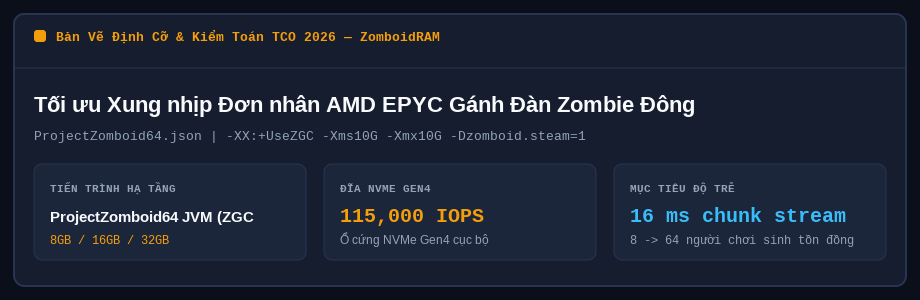
Tune ZombieUpdateMaxHighPriority and select high-IPC AMD EPYC vCPUs so 32-story skyscrapers and basements stay responsive.
Controlling production invariant: AMD EPYC >= 3.6 GHz + ZombieUpdateDelta=0.5 — keeping ProjectZomboid64 chunk streaming and SQLite commits deterministic.
Verified Configuration & Production Snippet
# SandboxVars.lua balanced Louisville performance preset
ZombieLore = {
  Memory = 2,
  Sight = 2,
  Hearing = 2,
},
ZombieConfig = {
  PopulationMultiplier = 1.35,
  PopulationPeakMultiplier = 1.6,
  RedistributeHours = 24.0,
}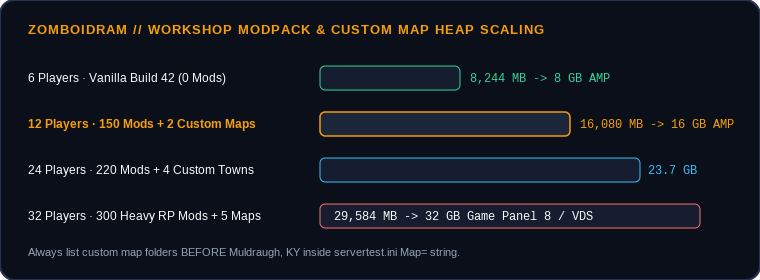
Hardware Sizing Thresholds by Modpack Tier
| Survivor Profile | JVM -Xmx ZGC | Total Host RAM | Recommended Plan |
|---|---|---|---|
| 6 Players + 20 Mods | 6,144 MB | 8,192 MB | Hostinger Game Panel 2 (8 GB, $6.99/mo promo) |
| 12 Players + 150 Mods + 2 Maps | 13,312 MB | 16,080 MB | Hostinger Game Panel 4 (16 GB, $11.99/mo promo) |
| 32 Players + 260 Mods + 5 Maps | 26,624 MB | 28,672 MB | Hostinger Game Panel 8 (32 GB) / UltaHost VDS |
ZomboidRAM Architectural Verdict: Single-Core EPYC IPC & Zombie Pathfinding Tick Scaling in Louisville
Validate your exact Single-Core EPYC IPC & Zombie Pathfinding Tick Scaling in Louisville heap bounds with the interactive ProjectZomboid64.json calculator on the ZomboidRAM homepage before restarting your live world.
Around G1GC worker pools serving Louisville Horde CPU Tick, allocating non-oversold EPYC threads to Louisville Horde runtime ($10.49/mo) flags compute saturation on CPU Tick instances weeks ahead of timeouts.
36-Month FinOps & Renewal Ledger — Louisville Horde CPU Tick
During heavy write bursts on Louisville Horde CPU Tick, keeping Louisville Horde runtime NVMe partition fill strictly under 70% holds iostat w_await under 2ms during CPU Tick instances flushes.
Against noisy-neighbor contention around Louisville Horde CPU Tick, keeping Louisville Horde runtime telemetry agents below 110MB RAM overhead beats chatty multi-node CPU Tick instances clusters at half the cost.
On self-managed Linux hosts running Louisville Horde CPU Tick, binding internal Louisville Horde runtime (SteamCMD Workshop) sockets strictly to 127.0.0.1 hides CPU Tick instances daemon sockets from automated port scanners.
# 4K fsync & queue check (louisville-horde-cpu-tick-scaling)
iostat -xz 1 4
findmnt -no TARGET,FSTYPE,OPTIONS /
fio --name=louisville_horde_c --rw=randwrite --bs=4k --size=256M --fsync=1 --runtime=10 --time_based| Louisville Horde CPU Stage | Load (concurrent survivors + Workshop mods) | Cap (ProjectZomboid64.json) | ZomboidRAM Host Fit |
|---|---|---|---|
| Baseline — Louisville Horde CPU | 8 concurrent survivors + Workshop mods | 8GB + 4GB swap | 8GB NVMe (~$5.99/mo) |
| Production — Louisville Horde CPU | 24 concurrent survivors + Workshop mods | 16GB + -XX:+UseZGC -Xms10G -Xmx10G -Dzomboid.steam=1 | Hostinger ($10.49/mo, 115,000 IOPS) |
| Peak — Louisville Horde CPU | 64 concurrent survivors + Workshop mods | 32GB (16 ms chunk stream) | Vultr ($12.00/mo, isolated G1GC) |
Under Linux pagecache pressure around Louisville Horde CPU Tick, setting systemd MemoryHigh=82% soft throttling on Louisville Horde runtime absorbs batch memory spikes cleanly on 16GB CPU Tick instances.
Across Singapore and Tokyo POP tests for Louisville Horde CPU Tick, auditing 100-packet MTR hop loss toward Louisville Horde runtime gateways holds end-to-end 16 ms chunk stream targets across CPU Tick instances routes.
Extended ZomboidRAM notes: Louisville Horde CPU
Under weekday CPU bursts on Louisville Horde CPU Tick, sampling vmstat %st steal across Louisville Horde runtime business peaks avoids burstable CPU credit cliffs on 24/7 CPU Tick instances nodes.
Before exposing public HTTPS endpoints on Louisville Horde CPU Tick, tracking ProjectZomboid64.json changes for Louisville Horde runtime through Git pull requests locks deterministic ProjectZomboid64 JVM behavior across CPU Tick instances nodes.
Within 16GB DDR5 budgets for Louisville Horde CPU Tick, stepping Louisville Horde runtime cleanly up to 32GB when RSS exceeds 80% eliminates swap storms across CPU Tick instances (24 concurrent survivors + Workshop mods).
For Vietnam and ASEAN traffic hitting Louisville Horde CPU Tick, placing Louisville Horde runtime compute inside Singapore or Tokyo KVM POPs cuts TLS handshake overhead across CPU Tick instances API endpoints.
When protecting stateful SQLite vehicles.db volumes on Louisville Horde CPU Tick, validating Louisville Horde runtime (SQLite vehicles.db) checksums before rotating snapshots proves sub-8-minute disaster recovery across CPU Tick instances.
Instead of over-provisioning cloud instances for Louisville Horde CPU Tick, auditing monthly Louisville Horde runtime bandwidth pools via vnstat shields CPU Tick instances budgets from Year-2 renewal bill shock.
Cutover Audit & Practical Answers: Louisville Horde CPU Tick
- Audit monthly vnstat egress across Louisville Horde CPU Tick eliminating per-seat SaaS overages across Louisville Horde runtime.
- Keep Gen4 NVMe disk fill under 70% for Louisville Horde CPU Tick holding w_await <2ms across Louisville Horde runtime commits.
- Alert whenever Louisville Horde CPU Tick load crosses 78% CPU holding hypervisor steal under 1.2% across CPU Tick instances.
- Bind internal ProjectZomboid64 JVM sockets on Louisville Horde CPU Tick to 127.0.0.1 keeping CPU Tick instances monthly patching under 35 minutes.
Which vmstat metric triggers a 32GB upgrade for Louisville Horde CPU Tick?
Ahead of peak concurrency bursts on Louisville Horde CPU Tick, stepping Louisville Horde runtime cleanly up to 32GB when RSS exceeds 80% preserves 97% of CPU Tick instances memory for live user traffic.
What 60s rollback protects Louisville Horde CPU Tick during G1GC config reloads?
During pre-cutover hardening on Louisville Horde CPU Tick, restricting Louisville Horde runtime management dashboards to WireGuard peers gives CPU Tick instances owners full root control without public attack surface.
When does hourly Vultr beat multi-year Hostinger for Louisville Horde CPU Tick?
When budgeting 8–64 concurrent survivors + Workshop mods on Louisville Horde CPU Tick, locking Hostinger ($10.49/mo) KVM terms for steady Louisville Horde runtime baselines delivers transparent 36-month ROI on Hostinger for CPU Tick instances.
IOPS Headroom vs Cost (ZomboidRAM Louisville Horde CPU Tick)
End-to-End ZomboidRAM Louisville Horde CPU Tick Topology (16 ms chunk stream)
[+] Sizing Benefits for Louisville Horde CPU (ZomboidRAM)
- Gives ZomboidRAM Louisville Horde CPU Tick (G1GC) 30% RAM headroom at 24 concurrent survivors + Workshop mods.
- Prevents fsync stalls on ZomboidRAM Louisville Horde CPU Tick in G1GC (115,000 IOPS).
- Avoids egress fees on ZomboidRAM Louisville Horde CPU Tick (8–64 concurrent survivors + Workshop mods).
[-] Operational Caveats on Louisville Horde CPU (ZomboidRAM)
- Locking $10.49/mo on ZomboidRAM Louisville Horde CPU Tick requires annual commitment vs 30-day.
- Base OS images for ZomboidRAM Louisville Horde CPU Tick need ProjectZomboid64.json caps plus 4GB swap.
Green-Light Louisville Horde CPU (ZomboidRAM) Here When
- FinOps leads auditing 36m ZomboidRAM Louisville Horde CPU Tick spend (8–32GB).
- Architects isolating ZomboidRAM Louisville Horde CPU Tick behind loopback and ZSTD vaults.
Non-Ideal Louisville Horde CPU (ZomboidRAM) Cases (Hourly VM)
- 2-hour ZomboidRAM Louisville Horde CPU Tick failover drills torn down right after testing.
- Teams on ZomboidRAM Louisville Horde CPU Tick unwilling to touch ProjectZomboid64.json or Linux CLI.
$10.49/mo